


 Connect with a PJM translator
 Font size
 Contrast version
 Monochrome version
 Text version
 Reset settings
Contact:
wlodzimierz.luczynski@umb.edu.pl
Update April 27th
The final schedule of OSCE exams, the final list of topics ("stations") and detailed regulations - see below.
OSCE
An objective structured clinical examination (OSCE) is a modern type of examination often used in medicine. It is designed to test clinical skill performance and competence in skills such as communication, clinical examination, medical procedures prescription, joint mobilisation/manipulation techniques and interpretation of results.
We prepared the OSCE exam as a practical classes during "chosen clinical course". Remember that division to the groups is different as during previous classes. All data concerning new groups were provided by Dean's Office of Medical Faculty.
In our department "OSCE exam" will be organized according to the following schedule - file for download below.
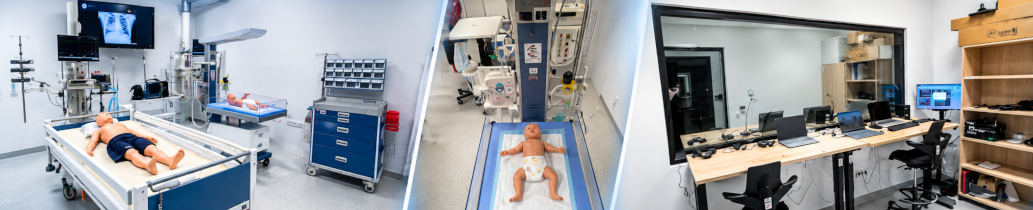
Lets meet in the main hall of our SimCenter. We start on May 5th ! Please, prepare theoretically and practically to the classes.
Students from the group come to the SimCenter only during the exact time marked "OSCE exam", You are free on the day "OSCE". For example 05.05 group 1 comes only at 8.00-10.00,. group 2 - 10.00-12.00, group 3 - 12.00-14.00. Etc.
Tutors from units should be present during the days marked "OSCE" between 7.30am to 2 pm; e.g. 05.05 and 6.05 following units should assign six tutors to SimCenter: KKiChWzOINK (2 tutors), KMR (1), KAiIT (1), KOTiChR (2 tutors).
Due to complicated schedule and organisation of the OSCE exam there is no possibility to change the number of the students in the group. In rare justified cases You can change the day of Your exam with other student one for one.
General regulations:
Practical classes called OSCE are the pilot version of the standardized exam of clinical skills including: taking history, physical examination, differential diagnosis and treatment (including practical procedures). We will use high- and low-fidelity simulations in SimCenter to achieve this purpose. Classes will be held during chosen clinical course according to the schedule.
Each student will have to pass seven "stations" = seven tasks individually (7 x 10 min). If a student will need a team member to complete the task, the objective team member will be provided be the SimCenter stuff (high-fidelity simulation - Room no 1). After entering the simulation room student will get her/his task printed. Please read the printed version carefully and complete strictly the task mentioned on the printed piece of paper. You have 10 minutes to complete the task. The end of the "station" will be announced by the voice of Big Brother "end of the station" or sound signal. After finishing the task student stays at the simulation room until the ring. After the ring student goes directly to the next station. The use of electronic devices in not allowed and will result in failure of the exam. For final credit You have to get positive grade in 4/7 stations, passing the high-fidelity station (No 1) is obligatory to get the positive grade.
Schedule of the day during OSCE classes:
- rules of the classes, introduction to the simulation environment (simulator, medical equipment, communication, overview of the stations) - 10 minutes
- seven "stations" for each student individually (7 x 10 minutes) - 70 minutes
- results and conclusions for the future - 10 minutes
Due to the limited time for OSCE the introduction and conclusions parts will be shortened to the minimum. Please read the detailed information about the rules.
Specific rules for OSCE exams 2026 (detailed information)
Examples of OSCE stations:
Intubation Part I (with English subtitles)
Intubation part II (with subtitles in English)
Electrotherapy (with subtiltes)
Trauma examination (with subtitles)
Topics of the practical classes during "OSCE exam" for the Year 2026:
- Bladder catheterization of an adults or a child (station obligatory for all students)
- Intubation - realized as technical station (station obligatory for all students)
- Measuring glycemia, hypoglycemia, hyperglycemia including ketoacidosis – diagnosis and treatment (doses are obligatory on this station)
- Hyper-, hypocalcemia – diagnosis and treatment.
- The case of the „acute abdomen” including physical examination.
- Heart attack – diagnosis and treatment (GPs office or Emergency Department).
- Atrial fibrillation.
- Collapse, bradycardia, tachycardia – diagnosis and treatment.
- Seizures – diagnosis and treatment
- Opioid poisoning / benzodiazepines poisoning
- Taking history in a simple complaint e.g. abdominal pain, asthma.
- Explaining to the patient how to use inhaler e.g. Turbuhaler
- Qualify (or not) for vaccination.
- Urine tract infection – diagnosis and treatment in children.
- Cystitis in children
- Renal colic, nephrotic syndrome, oedema.
- Gastrointestinal bleeding
- Migraine attack.
- Acute otitis media.
- Neurological examination. Guillain-Barre syndrome.
- Coeliac disease – diagnosis and treatment.
- Hypothyroidism / hyperthyroidism – diagnosis and treatment.
- Obese adolescent at the diabetologist’s / endocrinologist’s office.
- Scabies.
- Fungal infection of the skin
- Erythema migrans
- Swimming pool accident (resuscitaion of the child after drowning, use of AED)
- Lymphadenopathy. Cancer in children – diagnosis
- Child with rash (e.g. chickenpox)
- Adrenal crisis.
- Strep throat
- Acute ischemia of the lower limbs
- SPIKES
- Prostate enlargement
- Acute cholecystitis.
Organisation of the stations:
No 1 - High-fidelity with team member
No 2 - Intubation (technical station)
No 3 - Catheterisation (technical stasion)
No 4 - Simulated patient
No 5 - Technical station
No 6 - Simulated patient
No 7 - Simple technical station and few minutes rest :)
Good luck to everyone !
Wlodzimierz Luczynski and crew of SimCenter
PS. Novelty this Year: The most common students' mistakes during OSCE